Before any automation or AI goes in, we run a business and operational assessment — validating that your processes are optimized, standardized, and aligned to your strategy. That groundwork is what makes AI actually work.
Our starting point
Most AI initiatives fail for the same reason: they automate a broken process. Layering automation on top of unclear, undocumented, or inconsistent workflows just makes the chaos run faster. So we don't start with tools — we start with a business and operational assessment.
We come in and map how your business actually runs today: the processes, the procedures, the handoffs, and the tribal knowledge that lives in people's heads. Then we validate that every process is optimized, standardized, and aligned with your strategy before a single automation or AI capability is introduced.
You can't multiply what you haven't first made clear. Standardize the operation, then let AI scale it.
Only once that foundation is validated do we move to implementation — matching AI and automation to the places they genuinely create value, with the training that makes adoption stick. It's a deliberate sequence, and it's the reason our work holds up after we leave.
A framework we think in
Our operations-first approach also shapes how we see the AI era itself. Here's a framework we use to talk about what AI changed — and the new corner it exposed.
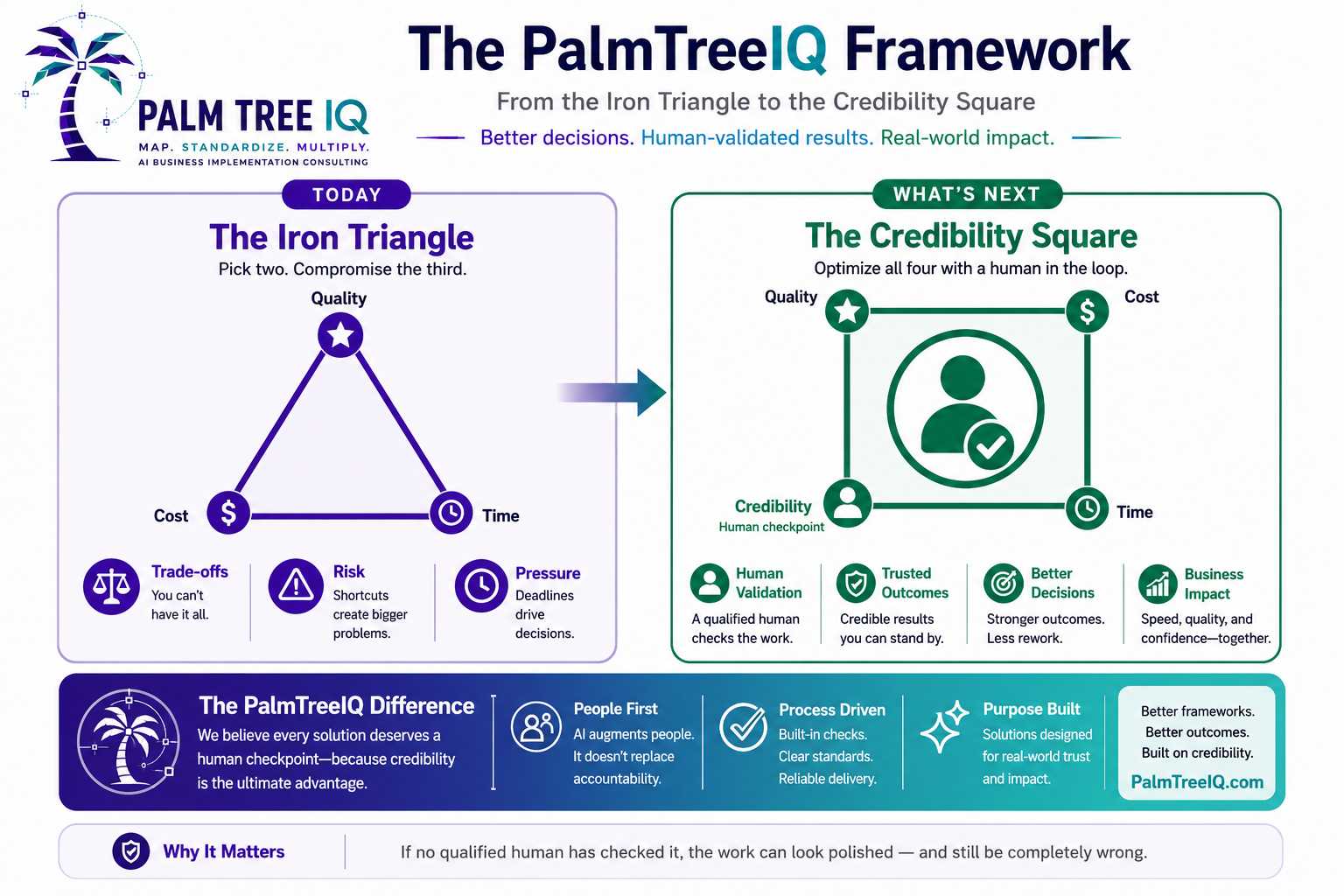 IQ Framework: from the Iron Triangle (quality, cost, time — pick two) to the Credibility Square (quality, cost, time, credibility — with a human in the loop)." />
The Palm Tree IQ Framework — adding the fourth corner the AI era exposed.
For decades we were taught the same iron triangle: quality, cost, time — pick two. You could move fast and cheap, but quality suffered. You could get quality fast, but it cost you. The constraint felt like a law of nature.
Having worked with resource-strapped startups, I've watched AI deliver quality work, fast and cheap — all three corners at once. The trade-off that defined operations for a generation simply stopped holding.
But collapsing the triangle exposed a fourth corner we never had to measure before: credibility.
If no qualified human has checked what the AI produced, the work can look polished and still be completely wrong. Fast, cheap, high-quality… and untrustworthy. So we're moving from a triangle to a square:
Where "a qualified human reviewed this" becomes something we actually measure. The same judgment that catches a phishing email is the judgment that vouches for the work. The task over the next two years isn't to automate that judgment away — it's to protect and certify it.
The goal isn't a human on everything — that doesn't scale, and it's exactly what turns review into rubber-stamping. Make credibility a measured gate at the points that matter:
The shift is from "review everything" to "certify judgment where it's load-bearing." That's the corner the square adds — and the work of the next two years.
The framework is in active development as a practical operating model. Let's talk about putting it to work.
Get in touch →